Let me start by saying this isn’t one of those generic, scripted posts you see on industrial equipment websites. I’m in the grading sorting machine game—been building, troubleshooting, and refining these machines for 12 years, and I still get asked the same question at trade shows, over Zoom calls, and in random late-night texts from growers, packers, and product line managers: “Can a grading sorting machine actually sort my stuff by weight, or is that just sales fluff?” Grading Sorting Machine
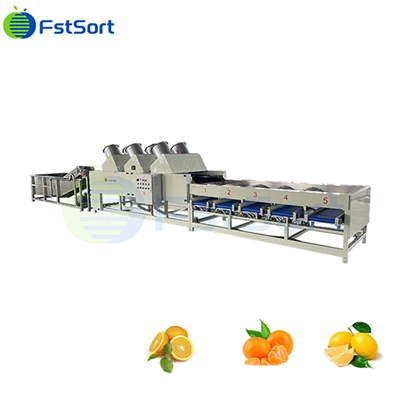
If you’re here for a yes/no answer, fair warning—this will take a minute, because the short answer is way more nuanced than you probably think. Let’s break this down like I would with a customer standing in my shop, pointing at a sample of blueberries, plums, or even frozen diced chicken thighs.
First, let’s get one thing straight: when most people say “sort by weight” for their products, they don’t mean just dumping them on a scale and labeling the heavy ones. They need accuracy, speed, and consistency—three things that separate a grading sorting machine that works from one that’s just taking up floor space. That’s where our machines (and all reputable ones, for that matter) come in, so let’s start with the tech that makes the weight sort possible.
The core component here isn’t some fancy sensor I can patent. It’s a load cell—think of it as a super-precise digital scale, but built to handle hundreds of products a minute, not a single one once a day. Load cells work by converting small weight forces into electrical signals, which the machine’s software translates into exact weight measurements. For context: a high-grade load cell can measure weight differences as tiny as 0.1 grams, which matters if you’re sorting 10-gram cherry tomatoes or 500-gram potatoes. Lower-end load cells? They can be off by several grams, which is useless for anyone needing uniform portions or grade compliance.
But here’s the part most salespeople skip: a grading sorting machine can only sort by weight well if two other factors are dialed in as tightly as the load cell. The first is product presentation. If you’re feeding round, bumpy avocados down a conveyor belt stacked two deep, some will bounce, shift, or even collide mid-measurement, throwing off the weight reading. Our machines use individual product lanes—called pocket conveyors—where each item sits alone, secured until it’s weighed. No stacking, no shifting, no collisions. For smaller products like olives or coffee beans, we use a vacuum pick-and-place system to set each item gently in its weighing pocket, so you’re not weighing two beans at once by accident.
The second big factor is speed. A grading sorting machine needs to move fast to keep up with most production lines, but if it moves too fast, the load cell can’t settle on a stable weight reading. Imagine stepping on a scale when you’re hopping around—you won’t get an accurate number, and it’s the same for tiny products. We calibrate our machines’ speed to the product: for small, lightweight items like raspberries, we cap speed at 120 pieces per minute, while for larger items like melons, we go slower (15 per minute) to ensure each item rests steadily on the load cell for 0.2 seconds—enough time for a precise reading, but not so slow that it bottlenecks your line.
Now, let’s talk about real-world applications, because this is where the rubber meets the road (literally, on the packing line). I’ve seen this work for everything from agricultural produce to processed food, even small industrial parts. Take a mid-sized peach orchard in Georgia we worked with last year. They were sorting peaches for grocery store bulk bins, where customers expect each peach in a bin to be within 2 ounces of each other. Before our machine, they were sorting by size alone—two peaches that looked identical could be half an ounce different in weight, leading to complaints from shoppers and rejections from the store.
We installed a weight-sorting module on their existing grading line. The machine weighed each peach, sorted them into five weight categories (from 4 ounces to 8 ounces, in 1-ounce increments) and routed them to the correct bin. The orchard told us later that their complaint rate for peach bins dropped by 85% in the first month, and they were able to charge 10 cents more per pound for their uniform batches. That’s the kind of real result that doesn’t come from a gimmick—it comes from a machine designed to handle weight sorting specifically.
Another example: a frozen food processor that makes pre-portioned grilled chicken for meal kits. They needed each package of chicken thighs to weigh exactly 12 ounces, give or take 0.25 ounces. Our grading sorting machine was integrated with their packaging line: it weighed each individual thigh, sorted out any that were too light or too heavy, and grouped ones within the weight tolerance together before packaging. Before, they had to add filler to light thighs or remove meat from heavy ones, wasting 12% of their product each week. After the machine, that waste dropped to less than 1%, saving them over $40,000 a year in raw material costs.
But here’s the catch: a grading sorting machine can’t sort every product by weight equally well. Soft, squishy items are the tricky ones. I once had a customer bring in ripe bananas to test on our machine, and we ran into a problem: as the banana moved down the conveyor, it would shift its shape slightly, changing the pressure on the load cell just enough to give a slightly inconsistent weight reading. We fixed it by adding a gentle, adjustable grip to the weighing pocket that held the banana’s ends in place without bruising it—something you don’t get on cheap, generic weight sorters. For products like this, custom adjustments are key, and that’s part of the service we provide, not an extra sales add-on.
Other limitations? If your product has a lot of debris, like stems attached to apples or dirt on potatoes, that can add extra weight and throw off readings. Our machines have a pre-sorting step that brushes off debris before the weight measurement, which solves that problem for most customers. For products that are irregularly shaped—like artichokes or unshaped nuts—we use a combination of weight and size sensors, but the weight sorting is still the primary driver of grade accuracy.
Now, I know what you’re thinking: “Why would I use a grading sorting machine for weight when I could just use a separate checkweigher?” Great question, and it’s one I get all the time. The difference is that a grading sorting machine does both: it can sort by weight, size, color, and even visual defects all in one pass, on the same line. A standalone checkweigher only measures weight, so you’d have to invest in two separate pieces of equipment, take up twice the floor space, and pay for two operators instead of one. For most mid to high-volume operations, a grading sorting machine is more cost-effective long-term.
Let’s talk about maintenance too, because no machine works forever, and cheap parts will fail. Our weight-sorting modules have load cells that are calibrated annually, which takes less than an hour with a standard test weight we provide. We also include a remote monitoring tool that lets us check the machine’s performance from our shop, so if the load cell is drifting, we can adjust it before it starts giving bad readings—no need to send a technician out for a service call unless it’s a major issue. Most of our customers tell us that once the machine is set up, maintenance is minimal—just a quick wipe-down of the conveyor belts and pockets every week.
So, circling back to the original question: Can a grading sorting machine sort products by weight? Yes—but only if it’s the right machine for your product, properly calibrated, and integrated with your existing line. You can’t buy a generic grading sorting machine off the shelf and expect it to sort your custom-sized frozen dumplings to within 0.5 grams without adjustments. But when it’s tailored to your product’s needs, those machines are one of the most reliable ways to achieve consistent weight grading, reduce waste, and keep your customers happy.
At the end of the day, I started in this business because I saw small growers and food processors getting burned by equipment that was overhyped and underbuilt. We don’t make one-size-fits-all machines. We sit down with you, look at your product, your line speed, your grade requirements, and build a weight-sorting module that fits your needs, no fluff, no hidden fees.

If you’re tired of inconsistent product grades, waste from off-weight items, or complaints from your customers because their batches don’t measure up, let’s chat. I can send you a sample weight-sorting test, walk you through how the machine would work on your line, and give you a clear picture of what it would cost and how quickly it would pay for itself. No sales pitch, no fine print—just real answers from someone who’s been in this business long enough to know what works.
Grading Sorting Machine References
- American Society of Agricultural and Biological Engineers (ASABE). (2021). Standard S361.4: Load Cell-Based Weight Measurement for Agricultural Product Sorting.
- Food and Agriculture Organization (FAO). (2020). Post-Harvest Sorting Technologies for Small-Scale Food Producers.
- International Society of Precision Agriculture (ISPA). (2022). Sensor Integration in Grading Equipment for Processed Food Applications.
- National Institute of Standards and Technology (NIST). (2023). Calibration Guidelines for Industrial Load Cells in Automated Sorting Systems.
Zhengzhou First Industry Co., Ltd.
As one of the most professional grading sorting machine manufacturers in China, we also support customized service. With abundant experience, we warmly welcome you to buy cheap grading sorting machine from our factory. For price consultation, contact us.
Address: No.72,11th Floor, Building 11, No.283 West Third Ring Road, High-tech Industrial Development Zone, Zhengzhou City, Henan Province
E-mail: media@fruitprocess.com
WebSite: https://www.fstsort-machine.com/
